Showing posts with label africa. Show all posts

Tuesday, February 1, 2011

Improved Treatment for Severe Malaria Saves More Lives

Malaria kills around one million people every year, with nine in ten deaths being in young African children. 
  • Severe malaria, marked by serious symptoms such as coma, convulsions, or difficulty breathing, progresses rapidly and is particularly deadly. Those who manage to survive are often left with life-long neurological damage.
  • Severe malaria is still mostly treated with the drug quinine, while uncomplicated malaria is treated with drugs containing derivates of artemisinin, an extract from a Chinese plant. In early 2010, the World Health Organization (WHO) strongly recommended that adults with severe malaria be treated with artesunate, a derivate of artemisinin, because it is more effective and has fewer side effects than quinine.
Now, the results from a large trial in nine African countries provide strong evidence that children would also benefit from the newer drug. MSF is already treating severe malaria in children with a drug derived from artemisinin and will now widely introduce artesunate. Artesunate should be used to treat both adults and children with severe malaria so that many more lives can be saved.
But wider obstacles remain: WHO treatment recommendations have yet to be revised in light of the latest evidence in children, and most countries have yet to recommend artesunate in place of quinine for either adults or children. And international donors have yet to put their full weight behind the latest evidence.
Enhanced by Zemanta

Breakthrough Meningitis Vaccine Developed for Africa at Affordable Price

          A new conjugate vaccine against meningococcus A costing only $0.5 (£0.3; €0.4) a dose that has been developed for use in Africa is about to be introduced for the first time in a national vaccination programme in Burkina Faso, researchers announced.
  • The campaign to vaccinate all children and young adults from the ages of 1 to 29 years with the vaccine, MenAfriVac, will begin in Burkina Faso on 6 December. Niger and Mali will follow with similar vaccination campaigns.
Countries in the so called meningitis belt in sub-Saharan Africa—from Senegal in the west to Somalia in the east—have had regular epidemics of meningococcal meningitis for the past century. Almost all of the major outbreaks are caused by group A Neisseria menigitidis.

Sources:
Enhanced by Zemanta

Saturday, January 8, 2011

Ebola - haemorrhagic fever

Ebola haemorrhagic fever (EHF) is a viral haemorrhagic fever and one of the most virulent viral diseases known to humankind.

The virus interferes with the endothelial cells lining the interior surface of blood vessels and with coagulation. As the blood vessel walls become damaged and destroyed, the platelets are unable to coagulate, patients succumb to hypovolemic shock. Ebola is transmitted through bodily fluids, while conjunctiva exposure may also lead to transmission.
There are five distinct species of the Ebola virus
  • Bundibugyo, 
  • Côte d’Ivoire, 
  • Reston, 
  • Sudan and 
  • Zaïre.  
Bundibugyo, Sudan and Zaïre species have been associated with large outbreaks of Ebola haemorrhagic fever (EHF) in Africa causing death in 25-90% of all clinically ill cases, while Côte d’Ivoire and Reston have not. 

The Ebola virus is transmitted by direct contact with the blood, body fluids and tissues of infected persons. Transmission of the Ebola virus has also occurred by handling sick or dead infected wild animals (chimpanzees, gorillas, monkeys, forest antelope, fruit bats). 
The predominant treatment is general supportive therapy.

More:

Enhanced by Zemanta

Sunday, December 12, 2010

"The Practice of Breast Ironing" -Female Genital Mutilation

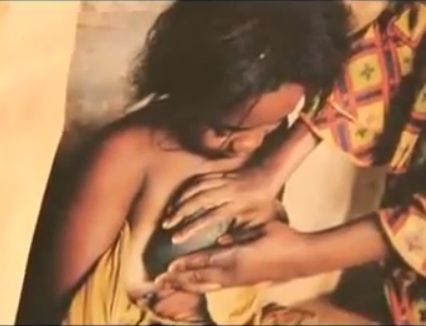
          Breast ironing is the practice of using various objects to massage or press on developing girls’ breasts to discourage growth. It is traditional in several areas of Africa, but notably in Cameroon, affecting 1 in 4 girls, according to a study by the development group Deutsche Gesellschaft für Technische Zusammenarbeit (GTZ).

Tools used in "Breast Ironing"

           Usually mothers or elders carry on this tradition meant to delay the appearance of sexual maturity and thus, delay sexual predation. The GTZ reports that the devastating psychological and physical health effects include “damaged tissue, open wounds, abscesses, infections, an elevated cancer risk,…difficulties with breastfeeding and trauma.


         Video:


      • As breast ironing is a burgeoning issue, current policy suggestions focus on education and awareness. The United Nation Population Fund (UNFPA) recommends that “governments in affected countries should raise public awareness of the dangers of breast ironing and why it needs to be stopped,” including “frank discussions of sexuality.” RENATA: National Network of Aunties Association (unwed young mothers trained in sexual health) and GTZ have set forth similar policy positions.
      While the World Health Organization has strongly recommended against female genital mutilation, it has yet to recognize the related health and human rights violations of breast ironing. Likewise, the Cameroonian Ministry of Health has not acknowledged the practice.


      Breast ironing should be acknowledged as a violation of women’s health and human rights, while addressing its deep cultural roots. Government and NGOs concerned with women’s rights must recognize it and support public awareness and education campaigns to discourage Cameroonian breast ironing.


       Sources:
      http://news.bbc.co.uk/2/hi/africa/5107360.stm
      http://www.huffingtonpost.com/2010/07/23/teenage-girls-undergo-bre_n_656965.html
      http://www.washingtonpost.com/wp-dyn/content/article/2010/03/04/AR2010030404489.html