Showing posts with label confidence. Show all posts

Sunday, January 9, 2011

Maslow's Hierarchy of Needs

Maslow's hierarchy of needs is a theory in psychology, proposed by Abraham Maslow in his 1943 paper A Theory of Human Motivation.

Maslow subsequently extended the idea to include his observations of humans' innate curiosity. His theories parallel many other theories of human developmental psychology, all of which focus on describing the stages of growth in humans.


Maslow studied what he called exemplary people such as Albert Einstein, Jane Addams, Eleanor Roosevelt, and Frederick Douglass rather than mentally ill or neurotic people, writing that "the study of crippled, stunted, immature, and unhealthy specimens can yield only a cripple psychology and a cripple philosophy." Maslow studied the healthiest 1% of the college student population.
Maslow's theory was fully expressed in his 1954 book Motivation and Personality.

Hierarchy

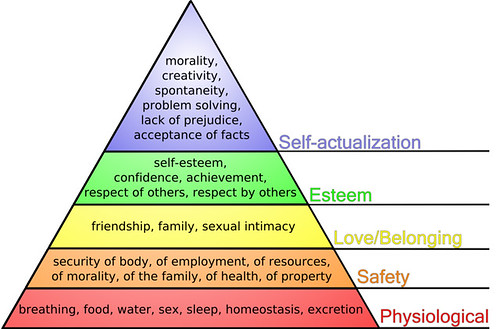
  • Maslow's hierarchy of needs is often portrayed in the shape of a pyramid, with the largest and most fundamental levels of needs at the bottom, and the need for self-actualization at the top.
  • The most fundamental and basic four layers of the pyramid contain what Maslow called "deficiency needs" or "d-needs": esteem , friendship and love, security, and physical needs. With the exception of the most fundamental (physiological) needs, if these "deficiency needs" are not met, the body gives no physical indication but the individual feels anxious and tense. Maslow's theory suggests that the most basic level of needs must be met before the individual will strongly desire (or focus motivation upon) the secondary or higher level needs. 
  • Maslow also coined the term Metamotivation to describe the motivation of people who go beyond the scope of the basic needs and strive for constant betterment. Meta-motivated people are driven by B-needs (Being Needs), instead of deficiency needs (D-Needs).


Physiological needs

For the most part, physiological needs are obvious — they are the literal requirements for human survival. If these requirements are not met, the human body simply cannot continue to function.
Air, water, and food are metabolic requirements for survival in all animals, including humans. Clothing and shelter provide necessary protection from the elements. The intensity of the human sexual instinct is shaped more by sexual competition than maintaining a birth rate adequate to survival of the species.

Safety needs

With their physical needs relatively satisfied, the individual's safety needs take precedence and dominate behavior. These needs have to do with people's yearning for a predictable orderly world in which perceived unfairness and inconsistency are under control, the familiar frequent and the unfamiliar rare. In the world of work, these safety needs manifest themselves in such things as a preference for job security, grievance procedures for protecting the individual from unilateral authority, savings accounts, insurance policies, reasonable disability accommodations, and the like.
Safety and Security needs include:
  • Personal security
  • Financial security
  • Health and well-being
  • Safety net against accidents/illness and their adverse impacts

Love and belonging

After physiological and safety needs are fulfilled, the third layer of human needs are social and involve feelings of belongingness. This aspect of Maslow's hierarchy involves emotionally based relationships in general, such as:
  • Friendship
  • Intimacy
  • Family
Humans need to feel a sense of belonging and acceptance, whether it comes from a large social group, such as clubs, office culture, religious groups, professional organizations, sports teams, gangs, or small social connections (family members, intimate partners, mentors, close colleagues, confidants). They need to love and be loved (sexually and non-sexually) by others. In the absence of these elements, many people become susceptible to loneliness, social anxiety, and clinical depression. This need for belonging can often overcome the physiological and security needs, depending on the strength of the peer pressure; an anorexic, for example, may ignore the need to eat and the security of health for a feeling of control and belonging.

Esteem

All humans have a need to be respected and to have self-esteem and self-respect. Also known as the belonging need, esteem presents the normal human desire to be accepted and valued by others. People need to engage themselves to gain recognition and have an activity or activities that give the person a sense of contribution, to feel accepted and self-valued, be it in a profession or hobby. Imbalances at this level can result in low self-esteem or an inferiority complex. People with low self-esteem need respect from others. They may seek fame or glory, which again depends on others. Note, however, that many people with low self-esteem will not be able to improve their view of themselves simply by receiving fame, respect, and glory externally, but must first accept themselves internally. Psychological imbalances such as depression can also prevent one from obtaining self-esteem on both levels.
Most people have a need for a stable self-respect and self-esteem. Maslow noted two versions of esteem needs, a lower one and a higher one. The lower one is the need for the respect of others, the need for status, recognition, fame, prestige, and attention. The higher one is the need for self-respect, the need for strength, competence, mastery, self-confidence, independence and freedom. The latter one ranks higher because it rests more on inner competence won through experience. Deprivation of these needs can lead to an inferiority complex, weakness and helplessness.
Maslow also states that even though these are examples of how the quest for knowledge is separate from basic needs he warns that these “two hierarchies are interrelated rather than sharply separated” (Maslow 97). This means that this level of need, as well as the next and highest level, are not strict, separate levels but closely related to others, and this is possibly the reason that these two levels of need are left out of most textbooks.

Self-actualization

“What a man can be, he must be.”
This forms the basis of the perceived need for self-actualization. This level of need pertains to what a person's full potential is and realizing that potential. Maslow describes this desire as the desire to become more and more what one is, to become everything that one is capable of becoming. This is a broad definition of the need for self-actualization, but when applied to individuals the need is specific. For example one individual may have the strong desire to become an ideal parent, in another it may be expressed athletically, and in another it may be expressed in painting, pictures, or inventions. As mentioned before, in order to reach a clear understanding of this level of need one must first not only achieve the previous needs, physiological, safety, love, and esteem, but master these needs.

International Business

Understanding the strengths and weakness of Maslow’s hierarchy of needs is important in the field of international business. Evaluating the different needs, values, drives and priorities of people from different countries - individualistic or collectivist - is incredibly valuable in cross-cultural communications, and especially within the workplace. It also illustrates how differences in values can greatly affect work atmosphere and work ethic between cultures: “ For example, societal cultures in many individualistic countries, such as the United States, may lead to an advantage in technological research and development. Many collectivistic societal cultures, such as that in Japan, may result in an advantage in workforce organization, quality control of products and service, and establishment of good relationships among contractees, suppliers and customers”.

Enhanced by Zemanta

Tuesday, August 31, 2010

Be a mentor.Build Self-Esteem.

                          You can't touch it, but it affects how you feel.
                          You can't see it, but it's there when you look at yourself in the mirror.
                          You can't hear it, but it's there every time you talk about yourself.
                          What is this important but mysterious thing?
                                             It's your self-esteem!
    • What Is Self-Esteem 
    • Why it is important
    • How to increase your esteem and self  confidence
    • Books and Articles you can read about self esteem 
       Knowing that Self-esteem should be taught to us since we crawl and as we get older we are developing our "self" , i added a more simple familiar text to be understood by all ages.
         
      • What Is Self-Esteem ?
                    To understand self-esteem, it helps to break the term into two words. Let's take a look at the word esteem (say: ess-teem) first. Esteem is a fancy word for thinking that someone or something is important or valuing that person or thing. For example, if you really admire your friend's dad because he volunteers at the fire department, it means you hold him in high esteem. And the special trophy for the most valuable player on a team is often called an esteemed trophy. This means the trophy stands for an important accomplishment.
             And self means, well, yourself! So put the two words together and it's easier to see what self-esteem is. It's how much you value yourself and how important you think you are. It's how you see yourself and how you feel about your achievements.
             Self-esteem isn't bragging about how great you are. It's more like quietly knowing that you're worth a lot (priceless, in fact!). It's not about thinking you're perfect — because nobody is — but knowing that you're worthy of being loved and accepted.
        Watch the Videos to see how  Media affects the teenagers :
         
               Self-esteem is a term used in psychology to reflect a person's overall evaluation or appraisal of his or her own worth. Self-esteem encompasses beliefs (for example, "I am competent" or "I am incompetent") and emotions such as triumph, despair, pride and shame. A person's self-esteem may be reflected in their behavior, such as in assertiveness, shyness, confidence or caution. Self-esteem can apply specifically to a particular dimension (for example, "I believe I am a good writer, and feel proud of that in particular") or have global extent (for example, "I believe I am a good person, and feel proud of myself in general").
        Psychologists usually regard self-esteem as an enduring personality characteristic ("trait" self-esteem), though normal, short-term variations ("state" self-esteem) also exist.
           Synonyms or near-synonyms of self-esteem include: self-worth, self-regard, self-respect, self-love (which can express overtones of self-promotion), and self-integrity. Self-esteem is distinct from self-confidence and self-efficacy, which involve beliefs about ability and future performance.
        • Why it is important?
                 Self-esteem isn't like a cool pair of sneakers that you'd love to have but don't have to have. A kid needs to have self-esteem. Good self-esteem is important because it helps you to hold your head high and feel proud of yourself and what you can do. It gives you the courage to try new things and the power to believe in yourself. It lets you respect yourself, even when you make mistakes. And when you respect yourself, adults and other kids usually respect you, too.
                 Having good self-esteem is also the ticket to making good choices about your mind and body. If you think you're important, you'll be less likely to follow the crowd if your friends are doing something dumb or dangerous. If you have good self-esteem, you know that you're smart enough to make your own decisions. You value your safety, your feelings, your health — your whole self! Good self-esteem helps you know that every part of you is worth caring for and protecting.
        Mental Health  (bbc.com)

        A Little on Low Self-Esteem

                 For the purposes of empirical research, psychologists typically assess self-esteem by a self-report inventory yielding a quantitative result. They establish the validity and reliability of the questionnaire prior to its use. Researchers are becoming more interested in measures of implicit self-esteem.
           Whereas popular lore recognizes just "high" self-esteem and "low" self-esteem, the Rosenberg Self-Esteem Scale (1965) and the Coopersmith Self-Esteem Inventory (1967/1981) both quantify it in more detail, and feature among the most widely used systems for measuring self-esteem.
        -The Rosenberg test usually uses a ten-question battery scored on a four-point response system that requires participants to indicate their level of agreement with a series of statements about themselves.
        -The Coopersmith Inventory uses a 50-question battery over a variety of topics and asks subjects whether they rate someone as similar or dissimilar to themselves.
                 Maybe you know kids with low self-esteem who don't think very highly of themselves or seem to criticize themselves too much. Or maybe you have low self-esteem and don't always feel very good about yourself or think you're important.
        Sometimes a kid will have low self-esteem if his mother or father doesn't encourage him enough or if there is a lot of yelling at home. Other times, a kid's self-esteem can be hurt in the classroom. A teacher may make a kid feel dumb or perhaps there is a bully who says hurtful things.
        For some kids, classes at school can seem so hard that they can't keep up or get the grades they'd hoped for. This can make them feel bad about themselves and hurt their self-esteem. Their self-esteem will improve when a teacher, tutor, or counselor encourages them, is patient, and helps them get back on track with learning. When they start to do well, their self-esteem will skyrocket!
        And some kids have good self-esteem but then something happens to change that. For example:
        • If a kid moves and doesn't make friends right away at the new school, he or she might start to feel bad.
        • Kids whose parents divorce also may find that this can affect self-esteem. They may feel unlovable or to blame for the divorce.
        • A kid who feels too fat or too thin may start thinking that means he or she isn't good enough.
        • A kid who's dealing with an illness, such as cancer, diabetes, or asthma, might feel different and less confident than before. 
        • Even going through the body changes of puberty — something that everybody does — can affect a kid's self-esteem.
        • How to Increase Your Self-Esteem?
              Of course it's OK to have ups and downs in your feelings, but having low self-esteem isn't OK. Feeling like you're not important can make you sad and can keep you from trying new things. It can keep you from making friends or hurt how you do at school.
        Having strong self-esteem is also a very big part of growing up. As you get older and face tough decisions — especially under peer pressure — the more self-esteem you have, the better. It's important to know you're worth a lot.
        If you think you might have low self-esteem, try talking to an adult you trust about it. He or she may be able to help you come up with some good ideas for building your self-esteem.
        In the meantime, here are a few things that you can try to increase your self-esteem:
        • Make a list of the stuff you're good at. It can be anything from drawing or singing to playing a sport or telling a good joke. If you're having trouble with your list, ask your mom or dad to help you with it. Then add a few things to the list that you'd like to be good at. Your mom or dad can help you plan a way to work on those skills or talents.
        • Give yourself three compliments every day. Don't just say, "I'm so great." Be specific about something good about yourself, like, "I was a good friend to Jill today" or "I did better on that test than I thought I would." While you're at it, before you go to bed every night, list three things in your day that really made you happy.
        • Remember that your body is your own, no matter what shape, size, or color it is. If you are worried about your weight or size, you can check with your doctor to make sure that things are OK. Remind yourself of things about your body that are cool, like, "My legs are strong and I can skate really well."
        • Remember that there are things about yourself you can't change. You should accept and love these things — such as skin color and shoe size — because they are part of you.
        • When you hear negative comments in your head, tell yourself to stop. When you do this, you take the power away from the voice inside that discourages you.
            By focusing on the good things you do and all your great qualities, you learn to love and accept yourself — the main ingredients for strong self-esteem! Even if you've got room for improvement (and who doesn't?) , realizing that you're valuable and important helps your self-esteem to shine.


        [The Dove Self-Esteem Fund - A Campaign for real beauty ]


        Enhanced by Zemanta