Tuesday, January 11, 2011

Paradise Syndrome

Paradise Syndrome, while not officially recognized by psychologists as a mental condition, is a term used by some to refer to a condition in which a person suffers a feeling of dissatisfaction despite having achieved all their dreams.

  • The term may have been coined by Dave Steward. It is often applied to individuals of such great wealth and success that they feel they no longer have anything left in life to accomplish. It is common with people who assign great value to their career and, although they have achieved much, do not feel satisfied.
  • "paradise syndrome" is a fictional creation, referring to an episode of Star Trek: "The Paradise Syndrome" is a third season episode of Star Trek: The Original Series, and was broadcast October 4, 1968. It is episode #58, production #58, written by Margaret Armen and directed by Jud Taylor.Since its inception it has been used to mean many different things, but in that episode it had more to do with being overworked and needing a break, rather than a feeling of dissatisfaction related to achieving one's dreams. http://www.imdb.com/title/tt0708475/

Source:  http://en.wikipedia.org/wiki/Paradise_Syndrome

Tools to help close the gender pay gap


In its ‘Strategy for equality between women and men 2010-2015’, the European Commission commits to supporting initiatives in the workplace which aim to encourage equal pay, such as the development of tools for employers to close unjustified gender pay gaps.

These tools include instruments designed to help employers, managers and human resources personnel identify if a company has a pay gap between its male and female employees. Such tools have been developed in countries including Germany, Luxembourg and Switzerland.
The software calculates whether there is a gender pay gap and if this gender pay gap is due to objective factors (such as a person’s level of education or years of service) or factors that cannot be explained and which, for the most part, it can be assumed are caused by pay discrimination.
If inequalities are found, advice and support is available to companies to help them develop solutions to close the gap.
Both the German and Luxembourgish calculators build on a Swiss calculator which was developed in 2009 by the country’s Federal Office for Equality between Women and Men.


Note: In Germany, the Logib-D (Lohngleichheit im Betrieb – Deutschland) management tool helps employers identify if there is a pay gap between their male and female employees. Through analyzing payment structures, this online tool enables employers to explore if a gender pay gap exists and the reasons for the gap. It also helps employers to develop solutions to ensure equal pay for all employees. The instrument was developed by the German Federal Government in cooperation with partners.
Enhanced by Zemanta

Sunday, January 9, 2011

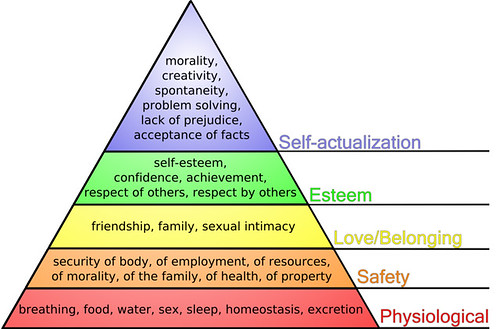
Maslow's Hierarchy of Needs

Maslow's hierarchy of needs is a theory in psychology, proposed by Abraham Maslow in his 1943 paper A Theory of Human Motivation.

Maslow subsequently extended the idea to include his observations of humans' innate curiosity. His theories parallel many other theories of human developmental psychology, all of which focus on describing the stages of growth in humans.


Maslow studied what he called exemplary people such as Albert Einstein, Jane Addams, Eleanor Roosevelt, and Frederick Douglass rather than mentally ill or neurotic people, writing that "the study of crippled, stunted, immature, and unhealthy specimens can yield only a cripple psychology and a cripple philosophy." Maslow studied the healthiest 1% of the college student population.
Maslow's theory was fully expressed in his 1954 book Motivation and Personality.

Hierarchy

  • Maslow's hierarchy of needs is often portrayed in the shape of a pyramid, with the largest and most fundamental levels of needs at the bottom, and the need for self-actualization at the top.
  • The most fundamental and basic four layers of the pyramid contain what Maslow called "deficiency needs" or "d-needs": esteem , friendship and love, security, and physical needs. With the exception of the most fundamental (physiological) needs, if these "deficiency needs" are not met, the body gives no physical indication but the individual feels anxious and tense. Maslow's theory suggests that the most basic level of needs must be met before the individual will strongly desire (or focus motivation upon) the secondary or higher level needs. 
  • Maslow also coined the term Metamotivation to describe the motivation of people who go beyond the scope of the basic needs and strive for constant betterment. Meta-motivated people are driven by B-needs (Being Needs), instead of deficiency needs (D-Needs).


Physiological needs

For the most part, physiological needs are obvious — they are the literal requirements for human survival. If these requirements are not met, the human body simply cannot continue to function.
Air, water, and food are metabolic requirements for survival in all animals, including humans. Clothing and shelter provide necessary protection from the elements. The intensity of the human sexual instinct is shaped more by sexual competition than maintaining a birth rate adequate to survival of the species.

Safety needs

With their physical needs relatively satisfied, the individual's safety needs take precedence and dominate behavior. These needs have to do with people's yearning for a predictable orderly world in which perceived unfairness and inconsistency are under control, the familiar frequent and the unfamiliar rare. In the world of work, these safety needs manifest themselves in such things as a preference for job security, grievance procedures for protecting the individual from unilateral authority, savings accounts, insurance policies, reasonable disability accommodations, and the like.
Safety and Security needs include:
  • Personal security
  • Financial security
  • Health and well-being
  • Safety net against accidents/illness and their adverse impacts

Love and belonging

After physiological and safety needs are fulfilled, the third layer of human needs are social and involve feelings of belongingness. This aspect of Maslow's hierarchy involves emotionally based relationships in general, such as:
  • Friendship
  • Intimacy
  • Family
Humans need to feel a sense of belonging and acceptance, whether it comes from a large social group, such as clubs, office culture, religious groups, professional organizations, sports teams, gangs, or small social connections (family members, intimate partners, mentors, close colleagues, confidants). They need to love and be loved (sexually and non-sexually) by others. In the absence of these elements, many people become susceptible to loneliness, social anxiety, and clinical depression. This need for belonging can often overcome the physiological and security needs, depending on the strength of the peer pressure; an anorexic, for example, may ignore the need to eat and the security of health for a feeling of control and belonging.

Esteem

All humans have a need to be respected and to have self-esteem and self-respect. Also known as the belonging need, esteem presents the normal human desire to be accepted and valued by others. People need to engage themselves to gain recognition and have an activity or activities that give the person a sense of contribution, to feel accepted and self-valued, be it in a profession or hobby. Imbalances at this level can result in low self-esteem or an inferiority complex. People with low self-esteem need respect from others. They may seek fame or glory, which again depends on others. Note, however, that many people with low self-esteem will not be able to improve their view of themselves simply by receiving fame, respect, and glory externally, but must first accept themselves internally. Psychological imbalances such as depression can also prevent one from obtaining self-esteem on both levels.
Most people have a need for a stable self-respect and self-esteem. Maslow noted two versions of esteem needs, a lower one and a higher one. The lower one is the need for the respect of others, the need for status, recognition, fame, prestige, and attention. The higher one is the need for self-respect, the need for strength, competence, mastery, self-confidence, independence and freedom. The latter one ranks higher because it rests more on inner competence won through experience. Deprivation of these needs can lead to an inferiority complex, weakness and helplessness.
Maslow also states that even though these are examples of how the quest for knowledge is separate from basic needs he warns that these “two hierarchies are interrelated rather than sharply separated” (Maslow 97). This means that this level of need, as well as the next and highest level, are not strict, separate levels but closely related to others, and this is possibly the reason that these two levels of need are left out of most textbooks.

Self-actualization

“What a man can be, he must be.”
This forms the basis of the perceived need for self-actualization. This level of need pertains to what a person's full potential is and realizing that potential. Maslow describes this desire as the desire to become more and more what one is, to become everything that one is capable of becoming. This is a broad definition of the need for self-actualization, but when applied to individuals the need is specific. For example one individual may have the strong desire to become an ideal parent, in another it may be expressed athletically, and in another it may be expressed in painting, pictures, or inventions. As mentioned before, in order to reach a clear understanding of this level of need one must first not only achieve the previous needs, physiological, safety, love, and esteem, but master these needs.

International Business

Understanding the strengths and weakness of Maslow’s hierarchy of needs is important in the field of international business. Evaluating the different needs, values, drives and priorities of people from different countries - individualistic or collectivist - is incredibly valuable in cross-cultural communications, and especially within the workplace. It also illustrates how differences in values can greatly affect work atmosphere and work ethic between cultures: “ For example, societal cultures in many individualistic countries, such as the United States, may lead to an advantage in technological research and development. Many collectivistic societal cultures, such as that in Japan, may result in an advantage in workforce organization, quality control of products and service, and establishment of good relationships among contractees, suppliers and customers”.
Enhanced by Zemanta

Stendhal Syndrome

Stendhal syndrome (Stendhal's syndrome, hyperkulturemia, or Florence syndrome) - is a psychosomatic illness that causes rapid heartbeat, dizziness, fainting, confusion and even hallucinations when an individual is exposed to art, usually when the art is particularly beautiful or a large amount of art is in a single place.

The term can also be used to describe a similar reaction to a surfeit of choice in other circumstances, e.g. when confronted with immense beauty in the natural world.

Italian scientists are to try to establish whether there really is such a phenomenon as 'Stendhal Syndrome' – the giddiness and confusion supposedly caused when one looks at great works of art.

The condition is named after the 19th century French author Stendhal, who wrote of feeling utterly overwhelmed by the Renaissance masterpieces he saw during a trip to Florence in 1817. 
"As I emerged from the porch of Santa Croce, I was seized with a fierce palpitation of the heart; the wellspring of life was dried up within me, and I walked in constant fear of falling to the ground," Stendhal, whose real name was Marie-Henrie Beyle, recorded in his book Naples and Florence: A Journey from Milan to Reggio.
Nearly two centuries on, researchers will use hi-tech recording instruments to measure visitors' reactions as they survey the treasures contained inside the Palazzo Medici Riccardi in Florence, Italy.
The scientists will monitor heart beat, blood pressure and rate of breathing as visitors take in the exquisite frescoes which adorn the palace.
Participants will afterwords be asked to write down their impressions of what they saw, and how they felt physically and emotionally.


Enhanced by Zemanta

Heterochromic Iris

Heterochromia= is the presence of different colored eyes in the same person. 

Heterochromia is uncommon in humans, but quite common in dogs (such as Dalmatians and Australian sheep dogs), cats, and horses.

Causes:Most cases of heterochromia are hereditary, caused by a disease or syndrome, or due to an injury. Sometimes one eye may change color following certain diseases or injuries.
Specific causes of eye color changes include:
  • Bleeding (hemorrhage)
  • Familial heterochromia
  • Foreign object in the eye
  • Glaucoma, or some medications used to treat it
  • Injury
  • Mild inflammation affecting only one eye
  • Neurofibromatosis
  • Waardenberg syndrome

When to Contact a Medical Professional

Consult your health care provider if you notice new changes in the color of one eye, or two differently colored eyes in your infant. A thorough eye examination is needed to be sure this isn't a symptom of a medical problem.
Some conditions and syndromes associated with heterochromia, such as pigmentary glaucoma, can only be detected by a thorough eye exam.

What to Expect at Your Office Visit

Your health care provider may ask the following questions to help evaluate the cause:
  • Did you notice the two different eye colors when the child was born, shortly after the birth, or recently?
  • Are any other symptoms present?
An infant with heterochromia should be examined by both a pediatrician and an ophthalmologist for other possible problems.
A complete eye examination can rule out most causes of heterochromia. If there doesn't seem to be an underlying disorder, no further testing may be necessary. If another disorder is suspected, diagnostic tests, such as blood tests or chromosome studies, may be done to confirm the diagnosis.
Enhanced by Zemanta

List of Educational Drug Films

         Drug films are films that depict drug usage, either as a major theme or as a few memorable scenes. Drug cinema ranges from the ultra-realistic to the utterly surreal; some movies are unabashedly pro- or anti-drug, while others are less judgmental.

The drugs most commonly shown in films are cocaine, heroin, LSD, cannabis (see Stoner film) and methamphetamine.


There is extensive overlap with crime movies, which are more likely to treat drugs as plot devices to keep the action moving. Some movies are mistakenly labeled as "drug films" due to their surreal nature, including 2001: A Space Odyssey, Waking Life and Yellow Submarine.

The following is a partial list of drug films and the substance involved:


Film Title Year Drugs Used
24 Hour Party People 2002 MDMA, Cocaine, Heroin, Methadone, Cannabis, and a mention of the multitude of crack in Barbados.
25th Hour 2002 Heroin, MDMA.
28 Days Later 2002 Prescriptions drugs (Valium).
28 Days 2000 Prescriptions drugs, Heroin, Alcohol.
39,90 2007 Cannabis, Cocaine
The 40-Year-Old Virgin 2004 Cannabis.
The 51st State 2001 POS 51 (a fictional drug) - also mentions Cocaine, LSD and MDMA.
54 1998 Marijuana, cocaine, MDA, quaaludes.
9 2009 Magnet (a fictional drug), used by 8 which apparently causes a drug like effect.
13 2010 Heroin, Morphine.

A

Film Title Year Drugs Used
A Bug and a Bag of Weed 2006 Cannabis.
A Nightmare on Elm Street 3: Dream Warriors 1987 Heroin.
A Very Brady Sequel 1996 Magic Mushrooms.
The Acid House 1998 LSD, Cannabis.
Across The Universe 2007 LSD, Cannabis, Some kind of Opiate, presumably Morphine.
Adam and Paul 2003 Cannabis, Heroin.
Adaptation. 2002 Fictional version of Ghost Orchid powder.
Addicted 2010 Cannabis, Heroin, Cocaine, DMT.
Adulthood 2008 Cannabis, Cocaine.
Adventureland 2009 Cannabis.
Air America 1990 Heroin, Opium.
Airplane! 1980 Cocaine, Glue.
A Home at the End of the World 2004 Cannabis, LSD.
Alice 1988 Amanita Muscaria.
Almost Famous 2000 Cannabis, Vicodin, LSD and Quaaludes.
Alpha Dog 2007 Cannabis.
Altered States 1980 LSD, DMT, and Amanita Muscaria.
American Beauty 1999 Cannabis.
American Gangster 2007 Heroin and cocaine.
American Psycho 2000 Cocaine, Halcion, Xanax, Ecstasy and Cannabis.
Amores Perros 2001 Cocaine.
Another Day in Paradise 1997 Heroin and cocaine.
Analyse That 2002 Cocaine.
The Anniversary Party 2001 MDMA.
Apocalypse Now 1979 LSD, opium, Cannabis and cocaine.
Arrebato 1979 Heroin, Cocaine and Amyl Nitrite.
Around the Fire 1999 Cannabis, LSD.
Assassin of Youth 1937 Marijuana.
Avenging Disco Godfather 1979 PCP.

B

Film Title Year Drugs Used
Bad Boys II 2003 MDMA and heroin.
Bad Lieutenant 1992 Crack, cocaine, heroin and cannabis.
Bang Boom Bang 1999 Cannabis.
Basic Instinct 1992 Cocaine.
The Basketball Diaries 1995 Heroin, cocaine, cannabis, solvents and various pills.
Batman Begins 2005 A fictional hallucinogenic gas.
Be.Angeled 2001 Cocaine, MDMA and Cannabis.
The Beach 2000 Cannabis, psychedelic mushrooms and stimulants.
Beavis and Butt-head Do America 1996 Peyote.
Beerfest 2006 Cannabis
Before the Devil Knows You're Dead 2007 Heroin (IV).
Belly 1998 Heroin and Cannabis.
Berlin Calling 2008 Cocaine, MDMA, Ketamine, Cannabis.
La Beuze 2003 Chemical cannabis which was made by Nazis during WWII that gives users hallucinations of Football players .
Beyond the Valley of the Dolls 1970 Cannabis, LSD, prescription pills, MDMA, peyote.
The Big Boss 1971 Heroin.
The Big Lebowski 1998 Cannabis, LSD.
Black Cat, White Cat 1998 Cocaine.
Blazing Saddles 1974 Cannabis.
Blow 2001 Cocaine and Cannabis.
Blueberry 2004 Ayahuasca, Peyote.
Blue Sunshine 1976 LSD.
Blue Velvet 1986 Nitrous Oxide.
Bobby 2006 LSD.
Boiler Room 2000 Cocaine.
Bounded By Blood 2010 Cocaine, ecstasy.
Bongwater 1997 Cannabis, LSD, and cocaine.
Boogie Nights 1997 Cannabis, Cocaine and methamphetamine.
The Boost 1988 Cocaine.
Borderland 2007 Cannabis and psychedelic mushrooms.
Boys Don't Cry 1999 Cannabis.
The Boys & Girls Guide to Getting Down 2006 Marijuana, ecstasy, cocaine, crack, heroin, speed, MDMA, viagra.
The Breakfast Club 1985 Cannabis.
Brick 2006 Heroin.
Bright Lights, Big City 1988 Cocaine.
Brokedown Palace 1999 Heroin.
Broken 2007 Heroin.
Broken Vessels 1999 Heroin and Meth.
Buffalo Soldiers 2001 Heroin and MDMA.
Bug 2007 Methamphetamine, marijuana.
Bullet 1996 Heroin.
Bully 2001 Cannabis, LSD, methamphetamine.
The Business' 2005 Cannabis, Ecstasy, Cocaine.

C

D

E

F

G

H

I

  • Idle Hands (1999). Marijuana.
  • If Drugs Were Legal (2009). Marijuana, cocaine, crack, ketamine, heroin, ecstasy, MDMA, LSD, amphetamines, and fictional drugs, first being dexclorazole which mimicks the affects of prozac but on a much larger scale and second being xp25 which stimulates of the serotonin neuro-transmitters in the brain but causes sudden heart attack.
  • Igby Goes Down (2002). Heroin and marijuana.
  • I Got The Hook Up (1998). Marijuana, cocaine and LSD.
  • I Love You Phillip Morris (2010). Heroin.
  • I'm Dancing as Fast as I Can (1982). Diazepam.
  • In Bruges (2008). Cocaine, Ketamine.
  • Inner Trial (2008). LSD, marijuana, psychedelic mushrooms.
  • Into the Blue (2005). Cocaine.
  • It's All Gone Pete Tong (2004). Cocaine, yopo snuff, and toad licking, presumably a reference to the Bufo Alvarius or Colorado River toad from which the extract should not actually be licked as in the movie, but smoked, due to bufo toxin which is incinerated upon smoking. Can contain 5-meo-dmt and/or bufotenin.

J

K

L

M

N

O

P

Q

R

S

T

U

V

  • Valley of the Dolls (1967). Barbiturates (Seconal, Nembutal, Amytal), amphetamines (Dexedrine), and Demerol.

W

Y

Z


Enhanced by Zemanta